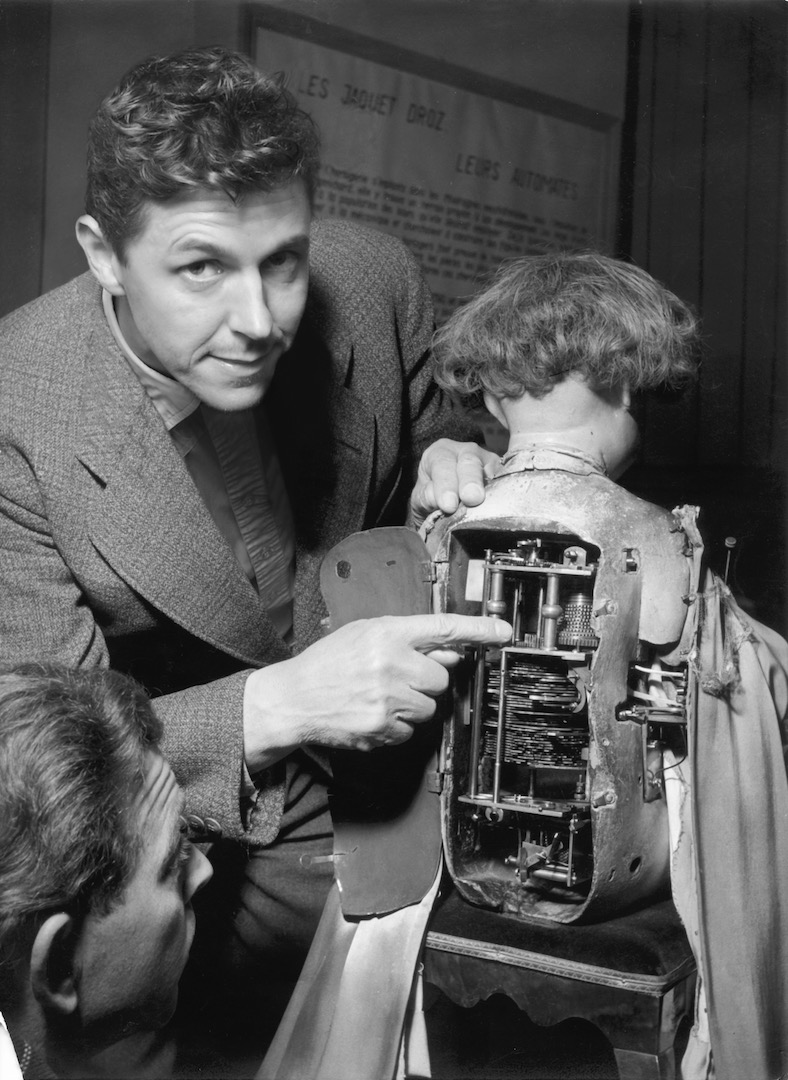
Koen Hauser (1972, NL) studied social psychology at the University of Leiden and photography at the Royal Academy of Art and the Gerrit Rietveld Academy.
He works with both his personal collection of reproductions of images resourced from old books, and institutional archives, including the Nationaal Archief, Kunstmuseum Den Haag, and the Rijksmuseum, where historical material becomes the starting point for new configurations rather than an object of documentation. His publications, including De Luister van het Land (in collaboration with Bart de Baets), extend this practice into the book as a spatial and temporal medium.
Hauser’s work has been exhibited internationally at venues such as FOAM, Unseen Photo Fair, Institut Néerlandais, and the He Xiang Ning Art Museum, and is held in public and private collections including Kunstmuseum Den Haag and the Houston Center for Photography.
Alongside his artistic practice, Hauser has been active in education, teaching at the Gerrit Rietveld Academy, the Willem de Kooning Academy, and at the Royal Academy of Art (KABK) in The Hague.
He works with both his personal collection of reproductions of images resourced from old books, and institutional archives, including the Nationaal Archief, Kunstmuseum Den Haag, and the Rijksmuseum, where historical material becomes the starting point for new configurations rather than an object of documentation. His publications, including De Luister van het Land (in collaboration with Bart de Baets), extend this practice into the book as a spatial and temporal medium.
Hauser’s work has been exhibited internationally at venues such as FOAM, Unseen Photo Fair, Institut Néerlandais, and the He Xiang Ning Art Museum, and is held in public and private collections including Kunstmuseum Den Haag and the Houston Center for Photography.
Alongside his artistic practice, Hauser has been active in education, teaching at the Gerrit Rietveld Academy, the Willem de Kooning Academy, and at the Royal Academy of Art (KABK) in The Hague.
AboutAt the core of Koen Hauser’s artistic practice lies the transformation of images. Drawing on a background in social psychology, years of experience in applied and fashion photography, and his work as a teacher at the Royal Academy of Art, his practice reflects a lifelong fascination with the image as both subject and material, looked at through the lenses of photography, psychology, and philosophy.
Working across photographic works, sculpture, installation, video and publications, Hauser uses transformation as both method and subject. His works originate in historical images drawn from his archive of photographic reproductions sourced from old books. He approaches these images not as fixed representations of reality, but as living matter—capable of shifting, accumulating meaning and taking on new forms. Through acts of editing, translation, and material reconfiguration, these images are set in motion, displaced from their original contexts and rearticulated as tactile and affective forms that render psychological processes and abstract notions tangible.
Personal experiences of isolation, loss and alienation quietly inform this practice. Rather than appearing as autobiography, they have shaped a sensitivity to what is overlooked, distorted, misunderstood or difficult to articulate, and to the capability of images to transform vulnerability and suffering into new forms of presence and meaning.
Ultimately, Hauser’s practice becomes a way of questioning the nature of reality itself. Across different media, memory, sensation, and imagination continually reshape one another until images no longer illustrate ideas but embody them, forming a mythology of perception.
Working across photographic works, sculpture, installation, video and publications, Hauser uses transformation as both method and subject. His works originate in historical images drawn from his archive of photographic reproductions sourced from old books. He approaches these images not as fixed representations of reality, but as living matter—capable of shifting, accumulating meaning and taking on new forms. Through acts of editing, translation, and material reconfiguration, these images are set in motion, displaced from their original contexts and rearticulated as tactile and affective forms that render psychological processes and abstract notions tangible.
Personal experiences of isolation, loss and alienation quietly inform this practice. Rather than appearing as autobiography, they have shaped a sensitivity to what is overlooked, distorted, misunderstood or difficult to articulate, and to the capability of images to transform vulnerability and suffering into new forms of presence and meaning.
Ultimately, Hauser’s practice becomes a way of questioning the nature of reality itself. Across different media, memory, sensation, and imagination continually reshape one another until images no longer illustrate ideas but embody them, forming a mythology of perception.